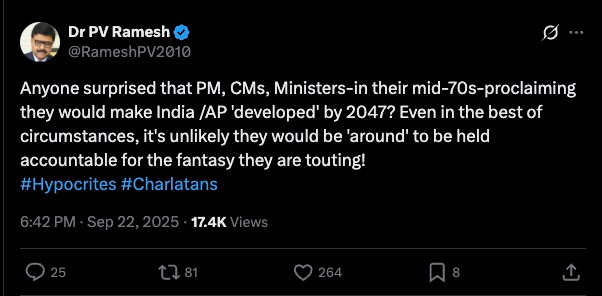
This tweet recently provoked me to articulate thoughts that have been weighing on my mind. Despite being 1.4 billion people, we lack thought leaders. We aren’t yet a knowledge society where everyone understands the intricacies of economy, planning, and opportunities. While half the population struggles with daily survival, much of our youth is consumed with entertainment rather than creation, lacking ambitious goals. In our conservative society, dreaming big itself seems distant. So when someone of such eminent background, who served in public service and should inspire people to think big, makes such dismissive statements, it provoked me to respond.
While I won’t delve into the intentions of the ex-officer who authored it, someone with a long career in public service whose qualifications, intellect, and capability I don’t question, I want to address the merits of his statement alone. I have expressed my critical reservations about civil servants before (https://x.com/hjasti/status/1896286754380140868), but this particular perspective demands a more nuanced response.
What Is Vision?
Vision is the ability to visualize something before it happens. It is a summary of objectives we aspire to achieve in the future, whether for personal life, organizations, communities led by powerful personalities, or even nation-states. It is a remarkable quality that anyone can cultivate, even if not possessed by default.
Consider the countless cases of disabled individuals who visualize themselves running in the future. This vision helps them overcome their struggles. When the seed of vision is sown, it takes root in the mind and returns repeatedly to push us toward our goals. The subconscious mind is a wonderful and extraordinary faculty that drives us toward the vision we hold.
While this applies to individuals, organizations can harness similar power when leadership teams create comprehensive plans with clear milestones and action items for their executive teams. The leadership enables executives to work collectively toward the organization’s vision.
Historical Precedents of Transformational Vision
Imagine Gandhi, Bose, or any freedom fighter holding a vision of independent India without knowing when, or if, they would ever see a free India. Martin Luther King Jr. wouldn’t have fought for civil rights without visualizing an equal society. Henry Ford’s vision propelled industrialization to unprecedented levels, envisioning a future that was incomprehensible to most of his contemporaries. We can quote many such examples like Nelson Mandela, Abraham Lincoln, Lee Kuan Yew etc. From recent times, Steve Jobs exemplified this visionary thinking, as does Elon Musk, who revolutionized space travel with reusable rockets and envisions humanity becoming a multi-planetary species.
Vision vs. Wishful Thinking
What distinguishes true vision from mere wishful thinking? A genuine vision transforms an ambitious dream into a framework grounded in reality. While vision provides a broad outline of objectives, it must be based on understanding present circumstances, learning from past experiences, and building capabilities we possess or plan to develop. The breadth allows for adaptation and evolution, but the foundation must remain solid. Without this grounding, even the grandest dreams remain fantasy.
The Abuse and Misuse of “Visionary”
Unfortunately, “visionary” has become one of the most abused terms in recent times, more so in political context. Many seek to appropriate this label for personal mileage. Some claim to have visions spanning 1,000 years, which borders on the ridiculous. A vision without an achievable timeline and defined action items is tantamount to blindness.
It requires tremendous leadership effort to rally crowds toward a vision and transform it into a collective aspiration for society. The transformed Singapore, a dramatically improved Rwanda, or the European Union conceptualized in the 1950s serve as brilliant examples of following a visionary path.
Complexity of Public Vision and Demographic Challenge
When it comes to public life, vision for nation-states, cities, and communities, the challenge becomes infinitely more complex. What might succeed in small, contained environments may face enormous obstacles when applied to broader geographies and diverse communities. Success depends entirely on leadership’s ability to communicate and embed their vision among the people they serve.
A leader’s vision will remain meaningless unless they can make it tangible for others. This requires either inspiring people to believe and participate, or demonstrating progress through clear roadmaps and achievable milestones. Without this translation from abstract dream to concrete reality, even brilliant visions become empty rhetoric.
The challenge becomes more complex and less convincing when the population is large, as in populous states and countries where significant fragmentation prevents unified commitment to a shared path. In a vibrant democracy like ours, continuity becomes even more challenging since electoral defeats can disrupt leadership. This cycle can repeat, extending timelines far beyond original aspirations.
Vision vs. Accountability
However, vision provides a broad outline of objectives. Over many years, trends, developments, innovations, and other changes can accelerate progress or redirect it entirely. Holding someone accountable for their vision seems amateurish given the challenges in democratic setup – leaders should be judged on their efforts and progress toward the vision, not on whether they personally achieve every stated goal. Even more childish is expecting leaders to limit their dreams to what they can personally witness in their lifetimes.
This represents a narrow mindset that one should only plan within their own lifespan. Great leaders, whether political or otherwise, don’t think solely about themselves or their limited time on earth. You may dismiss vision as fantasy or view visionaries as charlatans and hypocrites, but this reveals the limitations of your own perspective.
The Necessity of Constructive Debate
Debating a vision, its path, milestones, and timeline, is not only needed but essential. So-called visionaries and their credibility should absolutely be questioned. Their track records, where they exist, must be verified. These visions should be thoroughly discussed and critically analyzed. We don’t want another Adolf Hitler, whose contrived vision was detrimental and disastrous to the whole world. We should be highly vigilant against such dangerous visions.
But ridiculing someone simply for having a vision reveals a distorted understanding of leadership and progress. It betrays a poverty of imagination and an inability to appreciate the courage required to dream beyond one’s own existence.
Finally
True leadership requires the audacity to envision transformation that may outlive the visionary. While we must rigorously examine these visions and hold leaders accountable for their efforts toward achieving them, we must not mistake the courage to dream big for mere fantasy. The difference between a charlatan and a true visionary lies not in the scope of their dreams, but in their commitment to laying the groundwork for future generations to build upon.
We should encourage the courage to dream beyond one’s lifetime while maintaining the wisdom to distinguish between genuine vision and empty rhetoric.
Leave a Reply